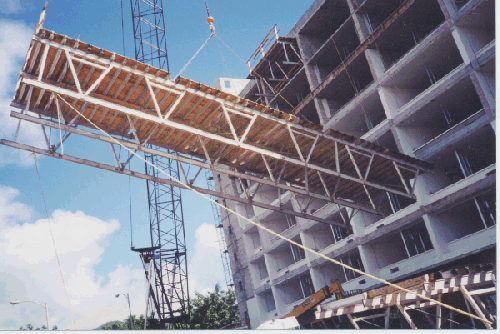
THE FLYING FORM CONSTRUCTION SYSTEM
Flying Form Tables consist of modular bearing members, TRUSSES with a DECK on top. The tables can be assembled differently for each job, according to the shape of the particular building.
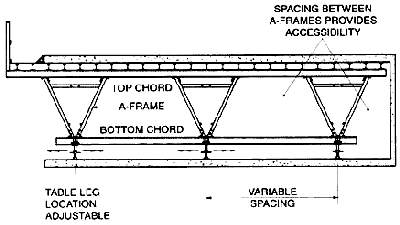
Each A-Frame Truss consists of four basic elements:
- TOP CHORD
- A-FRAME
- BOTTOM CHORD
- TABLE LEG -hinged
With the different possibilities of configuration of the four basic elements, the A-Frame Truss can be adapted to any type of high rise concrete structure.
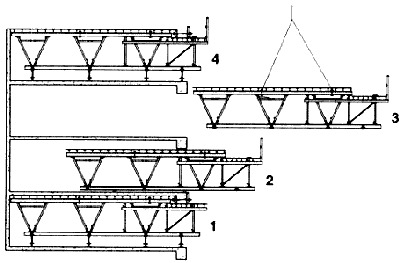
TYPICAL FLY FORM CYCLE
After pouring the concrete on top of the Flying Form Table, and after the concrete has hardened (1), the table forms are lowered from the concrete slab and then rolled outward from the building (2). The crane then lifts them as if they are flying (3), and "flown" on top of the previously poured slab (4). The method of table relocation gives this concrete forming system the name FLYING FORM SYSTEM and the tables FLYING FORM TABLES.
ADVANTAGES
- VARIABLE CAPACITY
The A-Frame connected to the top and bottom chord at any required location is the key to overall effectiveness of A-Frame Truss effectiveness.
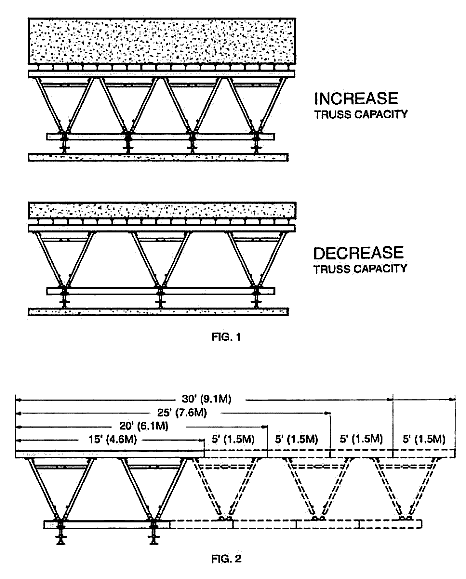
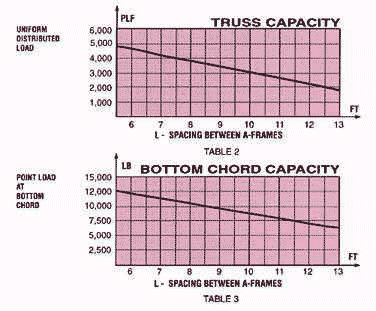
The unique variable spacing between A-Frames controls the capacity of the truss. When A-Frames are moved closer to each other, truss capacity increases, supporting the heavier concrete weight. Alternately, when A-Frames are moved apart, truss capacity decreases for lighter concrete weight. (Fig. 1)
ADAPTABILITY
The overall length of the A-Frame Flying Form Table is adjustable in increments of 5 feet (1.50m) (Fig. 2).
LIGHTWEIGHT
A-Frame Flying Form Tables can be assembled by hand or with a crane, unlike conventional systems that can only be assembled by crane.
A complete assembled A-Frame Truss of 30' in length is:
- 58% lighter than a conventional steel truss
- 20% lighter than a conventional aluminum truss
This allows for the use of larger forms with fewer joints between tables and fewer free form areas to fill.
ACCESSIBILTY
Due to the generous spacing between A-Frames, access is significantly improved below the about-to-be-poured concrete slab. This allows for more cost effective movement of men and materials in this area, as well as more thorough inspection of elevations and general condition of the forms.
HEIGHT ADJUSTMENT
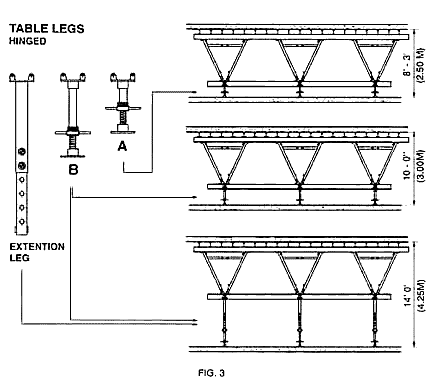
Support of concrete structures with different heights is simple and time saving. The use of table leg, type A or type B, is for floor heights from 8 feet (2.45m) to 10 feet (3.00m). For floor heights from 10 feet up to 14 feet (4.25m), extension legs are required in combination with one of the table legs. (Fig. 3).
All three types of table legs are connected to the bottom truss chord over the universal hinge device. Legs are simply and efficiently interchangeable on the same A-Frame truss, even during construction.
UNEVEN SLAB SHAPES
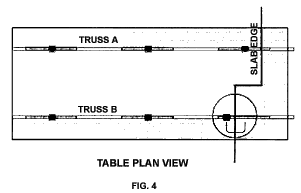
The position of the table leg connected by hinge to the truss bottom chord can be adjusted to accommodate any variations in the configuration of the slab edges. As an example (Fig. 4), this flexibility allows a leg on truss A of the table to be offset from the corresponding leg on the opposite truss B.
TRANSPORTATION AND STORAGE
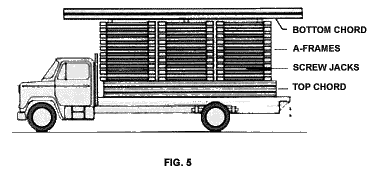
The various elements of this system are easily and compactly packaged for shipment or storage. For example, sufficient truss components to support 10,000 sq. ft. of suspended slab can conveniently be loaded on a 20' flatdeck (Fig. 5), while a compatible amount of the conventional truss system would require two 40' trailers.
This remarkable system addresses all of the conspicuous short-comings of the earlier truss designs, being much lighter, faster to assemble, more easily transported, and allowing more flexible table lengths and table leg locations than conventional trusses.
Our award- winning A-FRAME FLYING FORM is the only complete flying form today that meets the demand for a flexible and time saving construction system, accommodating both best and worst case scenarios.
DESIGN DATA
Using the high load carrying capacity of aluminum alloys for A-Frame Truss components, National Forming Systems Inc. is determined to remain at the forefront of quality, leading-edge design.
The A-Frame Truss is:
- A high strength rigid structure
- Made from lightweight aluminum members
- Durable under mechanical and weather conditions
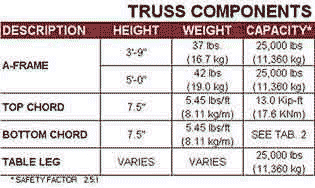
Individual capacities of A-Frame Truss components are determined by structural analysis and tests performed at the University of British Columbia and the British Columbia Research Institute, in Vancouver, Canada. The summaries of the results are shown on TABLE 1 and TABLE 2.
The Bottom Chord Capacity diagram on TABLE 3 must be followed only when the A-Frame Flying Form is relocated by the pinching method. The spacing 'L' between two A-Frames controls the point load developed on the Bottom Chord from pinching the table between two floors. (Fig. 1)